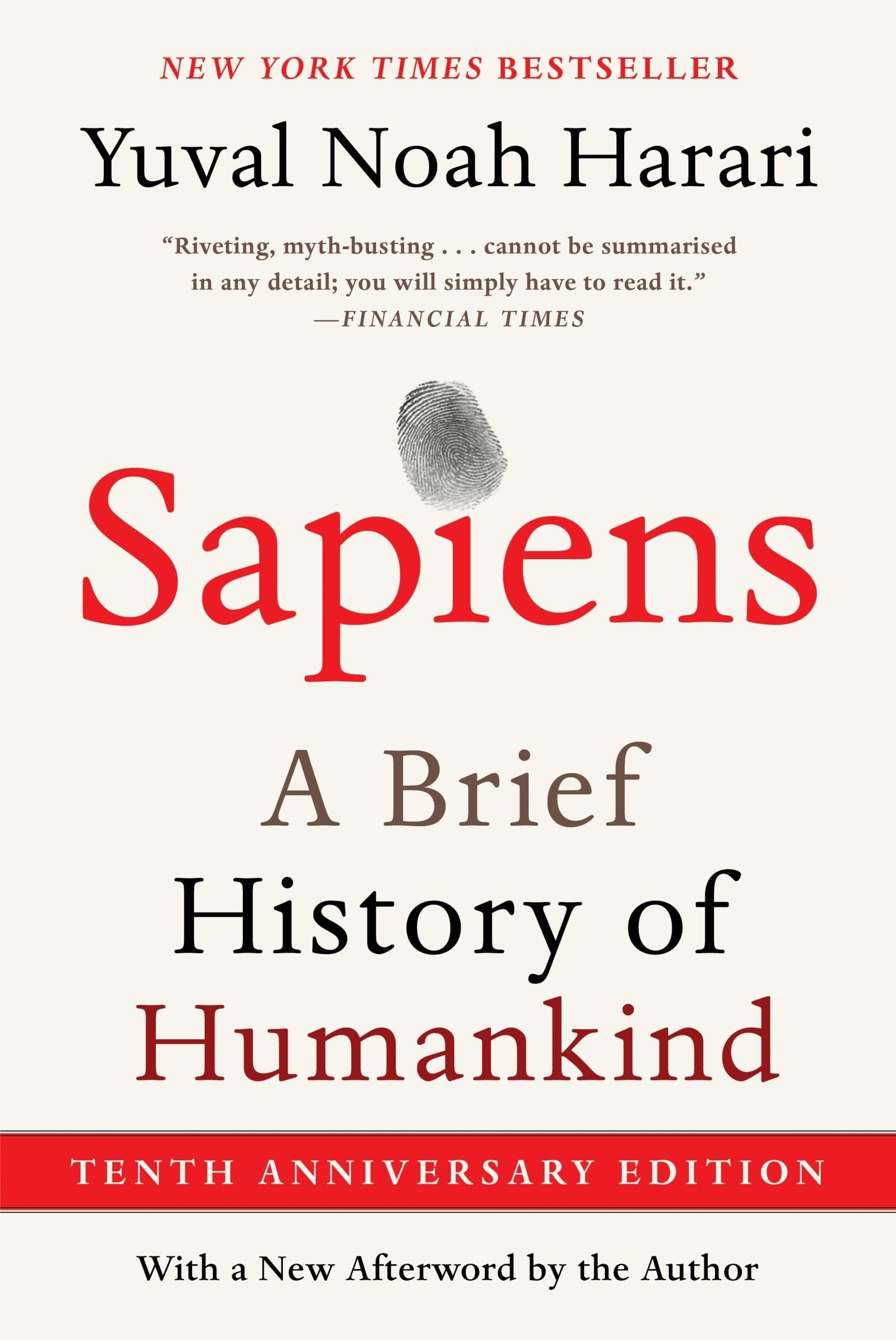
The tenth anniversary edition of the internationally bestselling phenomenon that cemented Yuval Noah Harari as one of the most prominent historians of our time—featuring a new afterword from the author.
One hundred thousand years ago, at least six human species inhabited the earth. Today there is just one. Us. Homo sapiens. How did our species succeed in the battle for dominance? Why did our foraging ancestors come together to create cities and kingdoms? How did we come to believe in gods, nations, and human rights; to trust money, books, and laws; and to be enslaved by bureaucracy, timetables, and consumerism? And what will our world be like in the millennia to come?
In Sapiens, Professor Yuval Noah Harari spans the whole of human history, from the very first humans to walk the earth to the radical—and sometimes devastating—breakthroughs of the Cognitive, Agricultural, and Scientific Revolutions. Drawing on insights from biology, …
The tenth anniversary edition of the internationally bestselling phenomenon that cemented Yuval Noah Harari as one of the most prominent historians of our time—featuring a new afterword from the author.
One hundred thousand years ago, at least six human species inhabited the earth. Today there is just one. Us. Homo sapiens. How did our species succeed in the battle for dominance? Why did our foraging ancestors come together to create cities and kingdoms? How did we come to believe in gods, nations, and human rights; to trust money, books, and laws; and to be enslaved by bureaucracy, timetables, and consumerism? And what will our world be like in the millennia to come?
In Sapiens, Professor Yuval Noah Harari spans the whole of human history, from the very first humans to walk the earth to the radical—and sometimes devastating—breakthroughs of the Cognitive, Agricultural, and Scientific Revolutions. Drawing on insights from biology, anthropology, paleontology, and economics, and incorporating full-color illustrations throughout the text, he explores how the currents of history have shaped our human societies, the animals and plants around us, and even our personalities. Can we ever free our behavior from the legacy of our ancestors? And what, if anything, can we do to influence the course of the centuries to come?
Bold, wide-ranging, and provocative, Sapiens integrates history and science to challenge everything we thought we knew about being human: our thoughts, our actions, our heritage...and our future.
La historia de la humanidad, desde un acercamiento biológico y antropológico. Sostiene un análisis casi neutral y semi lineal. La voz escribe en tercera persona lo que juega un papel interesante en la no identificación de la especie humana, y generar mayor comprensión de nuestra naturaleza.
This books tries to talk about everything but ends up talking about nothing.
It takes the sweetest bits, the sensational bits, from the most popular disciplines, smash them together to make a very provocative and fascinating book. Going through chapter after chapter felt like brainlessly scrolling through TikTok style videos, the obnoxious particular kind that start with the phrase "Did you knogw that...".
I think that Harari wanted to be impersonal while expounding his favourite scientific facts, nonetheless I found him to be tendentious and biased, even if only in a small number of occasions, particularly when adding to the fact.
Nice historical factoids, then a head-scratching over-simplification, followed by an assumption, etc. Sometimes felt like reading a puffed-up Wikipedia article.
Bon llibre que fa un repàs, evidentment succint, a la història de la humanitat des de l'inici fins, més o menys, ara, des d'un punt de vista molt crític al capitalisme, al liberalisme i a la forma de gestionar-ho tot que tenim els humans en general. Una molt bona, a estones densa, lectura.