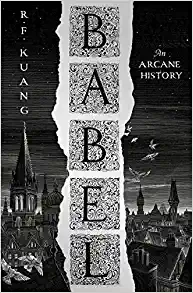
Traduttore, traditore: An act of translation is always an act of betrayal.1828. Robin Swift, orphaned by cholera in Canton, is brought to London by the mysterious Professor Lovell. There, he trains for years in Latin, Ancient Greek, and Chinese, all in preparation for the day he’ll enroll in Oxford University’s prestigious Royal Institute of Translation—also known as Babel.Babel is the world's center for translation and, more importantly, magic. Silver working—the art of manifesting the meaning lost in translation using enchanted silver bars—has made the British unparalleled in power, as its knowledge serves the Empire’s quest for colonization.For Robin, Oxford is a utopia dedicated to the pursuit of knowledge. But knowledge obeys power, and as a Chinese boy raised in Britain, Robin realizes serving Babel means betraying his motherland. As his studies progress, Robin finds himself caught between Babel and the shadowy Hermes Society, an organization dedicated to stopping imperial …
Traduttore, traditore: An act of translation is always an act of betrayal.1828. Robin Swift, orphaned by cholera in Canton, is brought to London by the mysterious Professor Lovell. There, he trains for years in Latin, Ancient Greek, and Chinese, all in preparation for the day he’ll enroll in Oxford University’s prestigious Royal Institute of Translation—also known as Babel.Babel is the world's center for translation and, more importantly, magic. Silver working—the art of manifesting the meaning lost in translation using enchanted silver bars—has made the British unparalleled in power, as its knowledge serves the Empire’s quest for colonization.For Robin, Oxford is a utopia dedicated to the pursuit of knowledge. But knowledge obeys power, and as a Chinese boy raised in Britain, Robin realizes serving Babel means betraying his motherland. As his studies progress, Robin finds himself caught between Babel and the shadowy Hermes Society, an organization dedicated to stopping imperial expansion. When Britain pursues an unjust war with China over silver and opium, Robin must decide…Can powerful institutions be changed from within, or does revolution always require violence?
Babel beats you over the head with how colonialism is bad. Not a bad take, far from it, but it's not the first book I've read on how such a practice is harmful for both ends of the arrangement. It's worth a read. It's entertaining and interesting, especially if you're interested in linguistics. But don't come in expecting a lot of subtly.
Terrible storytelling. 400+ pages before anything happened; before that it was all plodding tedium and navel-gazing.
Really, this is a set of essays pretending to be a story. There's an essay on colonialism, an essay on belonging, an essay on etymology; perhaps more. The reader is beat over the head repeatedly with the author's views, so that they get through to even the densest reader.
It's good to have this sort of thing existing in the world, I suppose, for the dunces in the back who don't get it. But I'm not sure they'll bother to read it. Indeed, I'm not sure who this book serves. Those who already get it don't need it.
I kept asking myself why I was still reading it, and I guess it boils down to social pressure because this is the first book in a new-to-me book club. Otherwise, it was too mediocre to …
Terrible storytelling. 400+ pages before anything happened; before that it was all plodding tedium and navel-gazing.
Really, this is a set of essays pretending to be a story. There's an essay on colonialism, an essay on belonging, an essay on etymology; perhaps more. The reader is beat over the head repeatedly with the author's views, so that they get through to even the densest reader.
It's good to have this sort of thing existing in the world, I suppose, for the dunces in the back who don't get it. But I'm not sure they'll bother to read it. Indeed, I'm not sure who this book serves. Those who already get it don't need it.
I kept asking myself why I was still reading it, and I guess it boils down to social pressure because this is the first book in a new-to-me book club. Otherwise, it was too mediocre to have bothered finishing.
Content warning: There are some upsetting scenes, just fyi. Abuse, death, and neglect feature heavily.
And then, after all that, there's no point to the story; no resolution.
Great themes, good characters, and thoughtful writing
No rating
What first struck me was how this book used a smidge of magic to allow certain aspects of themes to be easier to comprehend. The writing does something with themes where it makes them recognizable and able to be investigated in more profound ways by shearing off the sides, so to speak. Yet while I noticed this up front, I was surprised how deep the book went as it reached its zenith and turned toward a conclusion. There were comments about colonialism and empire that I recognized, but the way they were delved into thanks to the aforementioned tactic struck me more deeply than I could have expected. The characters, despite being somewhat symbolic in their deployment, also grew on me immensely. It made me think, and it made my eyes tear up a few times. And that's without mentioning all the fun translation, history, and cultural movement details the …
What first struck me was how this book used a smidge of magic to allow certain aspects of themes to be easier to comprehend. The writing does something with themes where it makes them recognizable and able to be investigated in more profound ways by shearing off the sides, so to speak. Yet while I noticed this up front, I was surprised how deep the book went as it reached its zenith and turned toward a conclusion. There were comments about colonialism and empire that I recognized, but the way they were delved into thanks to the aforementioned tactic struck me more deeply than I could have expected. The characters, despite being somewhat symbolic in their deployment, also grew on me immensely. It made me think, and it made my eyes tear up a few times. And that's without mentioning all the fun translation, history, and cultural movement details the writing wove in so elegantly! As a professional translator, it captured my intellect, my heart, and my imagination.
A truly amazing book. The voice is powerful, the vibe immaculate. I hate to compare a wonderful work of fantasy to Harry Potter, but it scratches an itch to have a British magical school story that is so well written. Also of note is the way she writes the main characters friendships, it is the most wholesome display of platonic devotion I've ever read. Between that and her descriptions of life on campus I feel like I lived the life of an academic, and experienced things second hand that I've never gotten the chance to before.
A long, heavy, beautifully written and very biting book about the ways in which colonialism coopts people and institutions, and the simultaneous difficulty and necessity of resisting that. Deeply and cleverly tied in with real 19th Century history of Britain and its empire, while also being a fantasy story with a very specific magic system that I enjoyed in itself.
I highly recommend this book, but it should also come with some content warnings:
* Colonialism
* Lots of depictions of racism
* Abusive parenting
* Abusive academia
* Violence
* Not afraid to kill important characters
What initially starts off as an imperfect blend of Tart's The Secret History and a low fantasy setting akin to Clarke's Jonathan Strange & Mr. Norrell slowly shifts to its actual subject: colonialism. Seen through the lens, not of white saviours nor the faraway colonial subjects, but of it's unique product: people of both worlds, forcefully transplanted, with all the twisted allegiances that come with it. The last third act of the book explodes into a study about struggle and violence, the interwoven working of class and empire, in a way that is seldomly seen in (Western) fiction literature and for this fact alone this book deserves praise and commendation.
It was OK. No surprises. Poor Character Development.
2 stars
2 stars means "It was OK".
If you already know a fair bit about Colonial British History, The Abolitionist Movement, The Opium Wars, Etymology, and Linguistics, then move along. You won't learn anything new. This book isn't written for you. I think it would be far more enjoyable if you know nothing of these subjects.
The magic system is interesting. Definitely some dark spots. The character development is not great. It would have been nice, for example, to have more character development of Victoire. We really only get a hint of it as what feels like an afterthought at the end. Ramy almost as bad. The main characters are all walking stereotypes, and each is simply an incarnation of their culture of origin. Even that exists not in a deep way, but mostly just as a function of their difference.
It was very transparent what the author was doing, all …
2 stars means "It was OK".
If you already know a fair bit about Colonial British History, The Abolitionist Movement, The Opium Wars, Etymology, and Linguistics, then move along. You won't learn anything new. This book isn't written for you. I think it would be far more enjoyable if you know nothing of these subjects.
The magic system is interesting. Definitely some dark spots. The character development is not great. It would have been nice, for example, to have more character development of Victoire. We really only get a hint of it as what feels like an afterthought at the end. Ramy almost as bad. The main characters are all walking stereotypes, and each is simply an incarnation of their culture of origin. Even that exists not in a deep way, but mostly just as a function of their difference.
It was very transparent what the author was doing, all the way through. There were a few moments of delight (mostly etymological in nature), but the ending is blindingly obvious from very early on in the book. There was only one actual surprise in the entire book (and that was in the timing of an event, not the actual event). So, for me, this is an OK Historical Fantasy with a cool linguistic magic system, very strong anti-colonial theme, poor character development of most characters, and you can see the end coming for hundreds of pages. It was difficult to stay engaged all the way to the finish, because so much was so obvious. This took me far longer to read than most Fantasy books, because it was just hard to keep slogging through for so long with no surprises and no character depth.
Kuang's story surprises. This coming-of-age (and coming-of-revolution) story introduces us to a world where the the 19th-century Industrial Revolution is made possible not by steam and worker oppression but by the magical powers of translation and colonial exploitation. The experiences of the protagonist, a Cantonese boy that adopts the English name Robin Swift, lead us to an imagined Oxford that is as intriguing as Hogwarts but that has sins that Kuang not only does not whitewash, but makes the centerpiece of her novel. The historical notes and especially the etymological explanations are fascinating, if occasionally pedantic. Once you get your head around this world and how it works, you'll want to hang on to the end to see how a postcolonial critique during the height of the British Empire can possibly turn out.
This memorable novel is both ingeniously creative and importantly timely in its message. R.F. Kuang weaves together a story that injects magical realism into a novel that is both historical and revisionist. That is, this is a story that asks us to imagine the road not taken at a certain time in history, and the ethics of the decisions of those in power–and question how and why such power came to be, in the first place.
I felt that the characters were well-developed and realistically complex, making it possible for the reader to feel the emotion in their stories. The plot was also well crafted and paced.
Instead of summarizing the plot, I want to simply recommend this novel, which I knew nothing about before I started reading. Part of the magic, for me, was simply reading on to discover the shape of the world as it is created by …
This memorable novel is both ingeniously creative and importantly timely in its message. R.F. Kuang weaves together a story that injects magical realism into a novel that is both historical and revisionist. That is, this is a story that asks us to imagine the road not taken at a certain time in history, and the ethics of the decisions of those in power–and question how and why such power came to be, in the first place.
I felt that the characters were well-developed and realistically complex, making it possible for the reader to feel the emotion in their stories. The plot was also well crafted and paced.
Instead of summarizing the plot, I want to simply recommend this novel, which I knew nothing about before I started reading. Part of the magic, for me, was simply reading on to discover the shape of the world as it is created by this author.
It was good, really good. The characters were interesting and three dimensional and enjoyable, the setting and plot was engaging and high stakes, and the translation lectures were tailor made for language nerds like me.
However, don’t do like I did and go into this expecting a fantasy novel. This is, mostly, historical fiction with a magic system reskinning technological progress in Victorian England.
This is not a knock on it, though, saying that it’s superfluous; it has a very interesting, if specific effect on the reader’s relationship with the world. It moves all of the varied goods and services that imperial Britain used to maintain power over their colonies into one spot and one profession: Oxford translators. As I see it, the silver magic system mostly exists to move the political center of Britain into this area. And I enjoyed it if only for this facet, if not for …
It was good, really good. The characters were interesting and three dimensional and enjoyable, the setting and plot was engaging and high stakes, and the translation lectures were tailor made for language nerds like me.
However, don’t do like I did and go into this expecting a fantasy novel. This is, mostly, historical fiction with a magic system reskinning technological progress in Victorian England.
This is not a knock on it, though, saying that it’s superfluous; it has a very interesting, if specific effect on the reader’s relationship with the world. It moves all of the varied goods and services that imperial Britain used to maintain power over their colonies into one spot and one profession: Oxford translators. As I see it, the silver magic system mostly exists to move the political center of Britain into this area. And I enjoyed it if only for this facet, if not for all the other symbolism it brings to the table.
However, I think it’s easy to be misled as a reader, that you will be seeing imaginative “what if?”s that are the bread and butter of alternate history fantasy novels.
To sum up, I recommend giving this novel a try if you are at all interested in Victorian England, in translation/linguistics, or just enjoy a really good, tragic, character driven story.
I did feel like this violated the dictum "show don't tell" a bit too much, but it has interesting characters and a gripping plot to go with it's anti-colonialism message. Can be read as a straight forward critique of imperialism, but there are also interesting connections (or at least possible interpretations relating) to the role of technology and technology driven capitalism in contemporary society.
Some frustration with footnotes (both spotting the asterix and how Kuang was using them - particularly early on - but there was a moment of clarity later on… but then Chapter 31 happened?!?) and that the queer characters were killed off and never able to tell each other they were head-over-heels (and not in a tragedy style way either)… but otherwise really good.
I love translation and the thought that goes into it - much of which is covered here.